
Engineers are builders and problem solvers, and nowhere are the abilities of NIU engineers showcased better than at the annual Senior Design Day.
At this event, teams of students present projects that they have researched, designed and even built to solve real-world problems. It is an opportunity for them to demonstrate the sort of insights and hands-on skills that are the hallmark of an NIU engineering degree.
This spring, 39 teams presented projects. Here is a brief look at the teams receiving awards for their work:
Helping infants hear
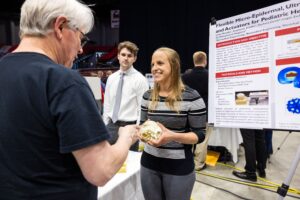 Team: Liam Murphy (Biomedical Engineering)
Stephanie Stadler (Biomedical Engineering)
Zachary Jacobi (Electrical Engineering)
Zschernitz Logan (Mechanical)
Award: Quality and Standards
This team helped improve a bandage-like hearing aid being developed at NIU that could allow children born with conductive hearing loss (which affects up to three out of every 1,000 children born in the U.S.) to hear. Their upgrade involved finding ways to more effectively transmit vibrations through bones in the skull to the inner ear. The team created various actuators and evaluated them on 3D-printed models of a human skull, a non-human primate skull and a pig’s head to assess function when brain matter and other tissues and fluids and skin are added into the equation.
A better way to test for pollutants
Team: Crystal Berrios (Biomedical Engineering)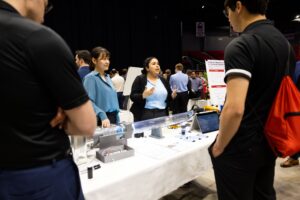
Christopher Vanderheiden (Mechanical Engineering)
Kanami Sugano (Mechanical Engineering)
Idalia Ruiz (Biomedical Engineering)
Award: Manufacturability
Companies that make equipment to test for air pollutants burn through a lot of equipment. As the filters clog, the motors driving the process overheat, perform less effectively and ultimately burn out. To overcome that issue, this team designed a system that utilized two types of sensors, including one that monitors a filter that catches dye droplets and shuts things down when it turns a specific shade of blue (which correlates to when the motor is nearing overload) and shuts down the machine before the motor is damaged.
A kit that helps build future engineers
Team: Mudassir Ansari (Mechanical Engineering)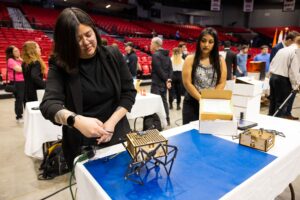
Arileny Espadas (Mechanical Engineering)
Christina Garcia (Mechanical Engineering)
Aman Madani (Electrical Engineering)
Award: Entrepreneurship
The future is filled with opportunities in the field of robotics. However, realizing that future will require a generation of new engineers. Recognizing that need, this team created a low-cost, reusable and educational robotics kit that could be accessible to any child, no matter their knowledge level or their family’s income level. The final product is a remote-controlled walking robot. In the process of building the robot, children can learn programming, mechanical and electrical skills.
Building better circuit boards for better production
Team: Msughter Dzoho (Electrical Engineering)
Ram Baran Raut (Mechatronics)
Hadi Raza (Electrical Engineering)
Award: Engineering Excellence
Precisely laying down layers of carbon fiber is an important part of the process that Ingersoll Machine Tools uses to create automotive and aircraft components and other products. To improve upon that process, this team designed new circuit boards to replace outmoded circuit boards that were plagued by issues such as crosstalk and overheating.
Spherical robot helps research roll along
Team: Catherine Calash (Mechanical Engineering)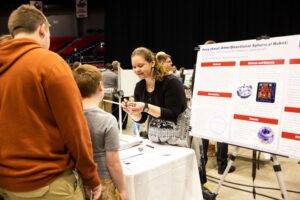
Richard Kopycinski (Mechanical Engineering)
Tommy Le (Mechanical Engineering)
Joshua Schrank (Mechanical Engineering)
Award: Application of Software in Engineering Projects
Researchers studying the behavior of small animals needed a small, highly maneuverable robot to assist them in that process. To that end, this team overhauled a previous generation of a small, autonomous and spherical robot. Upgrades included a dual-wheel drive configuration, various electronics, a custom-printed circuit board and a rechargeable battery. The updated robot, known as Pong, met the client’s design specifications and should be at work soon.
A new vision for a factory floor
Team: Ryan Burke (Industrial and Systems Engineering)
Elena Ruzzo (Industrial and Systems Engineering)
Nathan Webb (Industrial and Systems Engineering)
Award: Industrial Design
Batavia-based Suncast is the leading U.S.-based designer, manufacturer and distributor of high-quality resin products for home and industrial markets. To help keep up with demand, Suncast asked CEET students to analyze how the company batches parts and assembles final products. The team conducted an in-depth analysis of where parts were manufactured, where pieces were assembled, where they were shipped from and many other aspects of the production process. The resulting plan called for everything from relocating equipment to installing spring-loaded pallet positioners and industrial tape dispensers to help streamline the production process.
Lending a hand to shoppers with disabilities
Team: Mohamed Yousef (Mechanical Engineering)
Landon Buck (Mechanical Engineering)
James Franken (Mechanical Engineering)
Yaw Enin (Electrical Engineering)
Award: Judges Award
Motorized shopping carts for individuals with disabilities have become a common site in many grocery stores. As helpful as they are, they don’t solve all issues for individuals who might not be able to stand and reach items on higher shelves, requiring users to rely upon store employees or fellow shoppers for assistance. To help with that dilemma, this team designed a robot arm and gripper that can be attached to those carts. The team 3D-printed and assembled a version of an existing project that updated many of the components. Students also proposed replacing a PS2-style controller with a sensor-filled glove that could make using the arm much simpler.
The event, which was in May, featured 48 teams and attracted more than 900 people to the NIU Convocation Center to check out the projects. Next year’s showcase will be at the same location, 11 a.m. until 3 p.m. on May 3, 2024.
