
“Put yourself out there.”
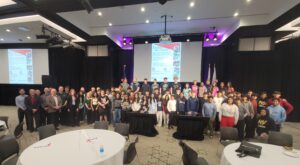
That was the advice Northern Illinois University engineering student Michael Duraski shared with more than 60 high school students during a recent National Engineers Week event at College of DuPage.
It’s also a principle the Bartlett High School graduate has followed throughout his own journey at NIU. In fact, Duraski’s willingness to seek out opportunities—from connecting with professors to gaining hands-on experience—helped lead to his selection as a student panelist at the event.
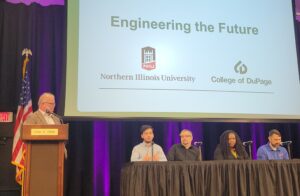
Now a senior majoring in mechatronics engineering who is also enrolled in the accelerated master’s degree program in mechanical engineering, Duraski traces his interest in the field to his time at Bartlett High. Since then, hands-on coursework and real-world experiences at NIU have helped shape his path.
He reflects on that journey in this Q & A with NIU’s College of Engineering and Engineering Technology.
What kind of activities did you participate in at Bartlett High School?
I played in an orchestra for the first few years of high school, but most of the other activities I participated in were focused on the STEM (Science, Technology, Engineering and Mathematics) fields.
Bartlett High offers a STEM focused program that most students simply referred to as “The Academy,” which allowed students to take advanced biology, chemistry, statistics, pre-calculus and calculus classes. More importantly for me personally, it also allowed students to take other classes such as CAD (computer-aided design) modeling, circuitry, and workshop and tool classes.
What did it mean to you personally to be sitting on that panel?
I was honored but at the same time, it was odd. I know it’s cliche, but it felt like only a few weeks ago I had been in their position listening to people talk about engineering at Bartlett High. Being a panelist made me realize how far I had come.
How have your internships or hands-on experiences shaped your understanding of what engineering is really like?
Engineering is very interdisciplinary, so it’s extremely common to see engineers working with other engineers from different specialties, or at times even people from different fields altogether.
An internship I had at Project C.U.R.E. (Commission on Urgent Relief and Equipment) focused on repairing used hospital equipment to be donated to hospitals and clinics internationally. Depending on what we were trying to fix, I had to work with electrical engineers, biomedical engineers, nurses and other professionals.
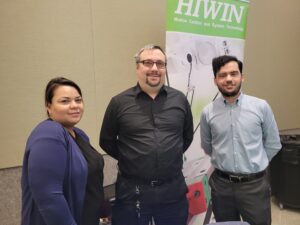
Engineers need to be flexible and understand a wide range of topics and know how to work together with others. It’s also very common to see people with a degree in engineering who end up going into many other fields, like education, sales, computer science and healthcare.
Where do you see yourself in 10 years — and how has your time at NIU CEET helped prepare you for that path?
Ideally, it would be my dream to help make the next Mars Rover. Over the years, my projects went from making simple obstacle-avoiding robot car kits to working with robot arms and making computer vision object-detection programs. Given more time, experience and practice, working on a rover could be in my future.
What’s one thing about CEET that surprised you — or that you think prospective students might not realize?
When I first started college, I thought the only solution if I was having trouble understanding something was to study harder, but I learned that most professors or teaching assistants are willing to answer questions over email or during office hours. There are also tutoring centers or programs to help students.
NIU has one of only six ABET-accredited bachelor of science in mechatronics engineering programs in the U.S. “Mechatronics” isn’t a term everyone is familiar with. How do you explain your major to friends or family — and what drew you to it?
Mechatronics is basically a fancy word for “robotics.” Formally, mechatronics is the combination of mechanical engineering, electrical engineering, computer science, and system dynamics and control, which is exactly what drew me towards it.
I started as an undecided engineering major so I could try a few classes from each field of engineering. When I learned more about it, I chose mechatronics because it is a combination of everything I enjoyed, including computer science.
If one student walked away remembering just one thing you said, what would you hope it was?
Put yourself out there.
Take part in programs and activities, meet people, join clubs or whatever other things you may be interested in. You won’t realize how many opportunities there are until you go looking for them. Even if that opportunity doesn’t lead anywhere, you’ll learn from the experience.
