
Setting clear expectations. Nurturing creative freedom. Keeping an open mind.
These ingredients all describe Associate Professor Ziteng Wang, according to undergraduate students he’s mentored. Last week, those strengths were cited in an NIU Today announcement of Wang’s selection for the Conference on Undergraduate Research and Engagement (CURE) Faculty Mentor of the Year.
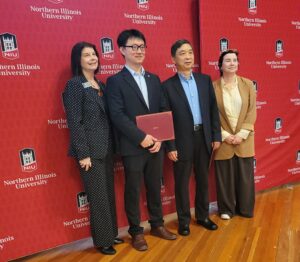
The honor puts the spotlight on faculty who guide undergraduate students through meaningful, hands-on research experiences, which often serve as catalysts for confidence, curiosity and academic growth.
An associate professor in the Department of Industrial and Systems Engineering, Wang’s accessibility and encouragement shined through in student’s remarks.
“Through his mentorship and open-mindedness, I was able to approach him with new ideas and creative solutions; this helped boost my confidence with problem-solving and independent research,” said ISYE senior Jack Rissman.
Angelica Sanyal, a sophomore ISYE major, praised Wang for helping her technical and communication skills development.
“He has provided opportunities for professional growth, and his mentorship has helped me see how my skills as an engineer can contribute to meaningful research and real-world impact,” Sanyal said.
The Undergraduate Research Mentorship Awards are a key part of NIU’s broader effort to elevate undergraduate research, recognizing faculty who balance technical expertise with a genuine investment in student success.
For Wang, the recognition is less about individual achievement and more about the students themselves. “I am honored to receive this award and more importantly, to have worked with so many talented students,” Wang said. “It’s really their curiosity and persistence that drive the work. I’m just glad to play a small role in helping them take the next step.”
A year ago, Wang received the largest grant at Huskie Trek Talks: Ideas in Motion: $15,000 to develop and launch an app for parents to have their child’s walking pattern analyzed for early autism detection. That work continues, and Wang expects a formal launch of the app in Fall 2026. Wang and his research team also received $100,000 from NIH’s AIM-AHEAD program to establish the AI-LEADS lab for advancing AI for health research.
Related: AI LEADS transform autism screening through AI-powered gait
