
CS Nam, chair of the Department of Industrial and Systems Engineering (ISYE). is the primary editor of a book that was published this month, “Human-Centered Metaverse: Concepts, Methods, and Applications.”
The 276-page book focuses on the understanding of the metaverse and the factors that influence human-AI interaction.
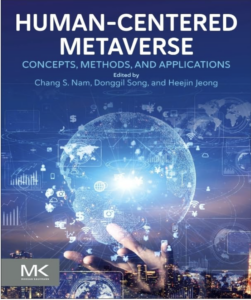
It provides an up-to-date repository of theory, fundamentals, techniques, and diverse applications, and comprehensively addresses recent and rapid changes in the field of human-centered metaverse.
“Since there are few books that address the human-centered metaverse, readers would find this book easily digestible,” Nam said. “I hope it inspires confidence to understand more, including research challenges and open issues.”
Generally, the metaverse is a virtual world where people can work, play and socialize in a way that’s similar to the real world.
The other editors for “Human-Centered Metaverse” are Donggil Song, Associate Professor of engineering technology and industrial distribution at Texas A&M University’s College of Engineering, and Heejin Jeong, Assistant Professor of human systems engineering in The Polytechnic School.
Nam’s teaching and research interests center around brain-computer interfaces, social cognitive neuroscience, and human-explainable AI-robot teaming (HEART).
Since 2014, he has also served as Editor-in-Chief of the journal “Brain-Computer Interfaces”; its name will be changed to “Research in Biomedical Engineering and Technology” in 2025.
Nam, who joined NIU on July 1, has five other edited books to his credit: “Trust in Human-Robot Interaction: Research and Applications,” “Neuroergonomics: Principles and Practices,” “Mobile Brain-Body Imaging and the Neuroscience of Art, Innovation and Creativity,” “Human-Centered Artificial Intelligence: Research and Applications” and “Brain-Computer Interfaces Handbook: Technological and Theoretical Advances.”
The last of those books was selected by Taylor & Francis as the 2018 Outstanding Book in STEM.
