
Northern Illinois University’s Department of Engineering Technology is making waves in sustainable material research with its bioplastics laboratory.
This facility addresses one of the world’s most pressing challenges: the environmental impact of plastic pollution. Through advanced research, experimentation, and industrial collaboration, the lab is pioneering innovative solutions to develop biodegradable materials that promise a greener future.
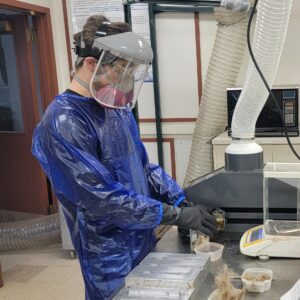
For businesses, researchers and students, it offers a glimpse into a future where materials biodegrade, waste is minimized and sustainability drives progress.
A Vision for Sustainable Materials
Plastics have long been a cornerstone of modern manufacturing, particularly in packaging and consumer goods. Yet, their durability comes at a steep environmental cost, with millions of tons accumulating in landfills and oceans every year.
At the bioplastics lab, researchers are working to replace conventional petroleum-based plastics with biodegradable and renewable alternatives. Their primary focus? Leveraging natural fibers and bio-based polymers (fermentation-based, starch-based, cellulose-based and protein-based) to create sustainable composites that decompose safely in the environment.
Under the leadership of Dr. Mahdi Vaezi, the lab’s multidisciplinary team is exploring the integration of hemp and soy fibers, as well as other renewable additives to produce materials tailored for industrial-scale production. Their work aligns with global trends toward circular economy principles, where materials are reused, recycled, and returned to nature with minimal harm.
A Hub for Education and Collaboration
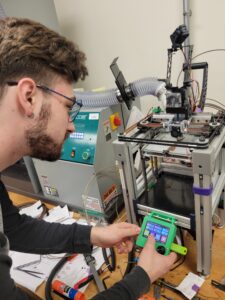
The bioplastics lab isn’t just a research facility—it’s a hub for student engagement and industry collaboration while fostering partnerships with businesses seeking to adopt eco-friendly practices. Undergrad and grad students gain hands-on experience with advanced manufacturing technologies, preparing them for careers in sustainability-focused industries.
Ian Janusz, an undergrad student who works in the lab, called his experience “an incredible hands-on opportunity to develop problem-solving skills and apply my knowledge of additive manufacturing and material science.”
“This research has allowed me to contribute to developing sustainable alternatives to traditional plastics,” he added. “It’s also equipped me with the skills and mindset to thrive in the rapidly evolving field of biomaterials.”
Ryan Mueller is a grad student who also works in the lab. He said the highly collaborative experience has augmented his academic pursuits. “Earning a degree here is more than just a piece of paper from checking all the university’s boxes,” Mueller said. “The NIU bioplastics lab has allowed me to greatly expand the value of my education.”
Cutting-Edge Facilities and Capabilities
The lab houses industry-standard equipment to design, produce, and test bio-based materials. Among the lab’s standout capabilities are:
- Plastics Production and Prototyping Technologies
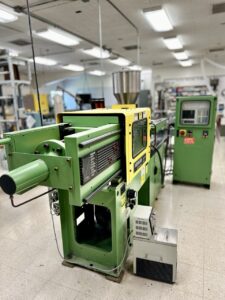
The lab utilizes a diverse array of plastics production technologies, including extrusion, injection molding, blow molding, thermoforming, rotational molding, composite hand-layup and pelletizing, to support sustainable material development and manufacturing.
These methods allow the lab to create a wide range of products, from biodegradable pellets and sheets to hollow containers, thin-walled packaging, durable structural components, and custom composite designs. In the process, the lab replicates real-world manufacturing conditions, enabling the production of prototypes and scalable solutions tailored to the needs of industries seeking environmentally friendly alternatives.
- Mechanical and Permeation Testing
The lab conducts comprehensive mechanical and permeation testing to rigorously evaluate the performance of its bioplastics, ensuring they meet the stringent demands of industries like food packaging. These evaluations include testing for tensile strength, water vapor and oxygen barrier properties, and melt flow indexing, as well as assessing wear, tear, hardness, impact, and compression under ASTM and ISO standards.
Using advanced tools such as humidity chambers and coordinate measuring machines (CMM), the lab ensures precise measurements and replicates real-world conditions to validate material quality and performance across various applications.
- 3D Printing Research
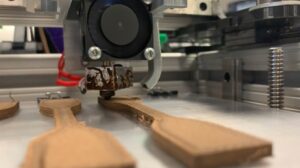
Leveraging fused deposition modeling (FDM), the lab has developed hemp-based filaments that offer flexibility, strength and eco-friendly properties for additive manufacturing. This work demonstrates the versatility of bioplastics for applications ranging from prototyping to end-use products.
The facility’s advanced capabilities enable seamless scaling from research to commercial production, filling a critical gap between laboratory experimentation and industry adoption.
Key Research Initiatives
The lab’s recent studies highlight the transformative potential of bioplastics:
Biodegradable Food Packaging
- The team has recently developed bio-based polymer blends with hemp fibers. These composites exhibit excellent mechanical strength, oxygen barrier properties, and environmental performance, making them ideal for food packaging applications. By using sustainable hemp fibers and bio-based additives, the materials reduce reliance on fossil fuels while maintaining food safety standards.
- Hemp-Based 3D Printing Filaments
In the realm of additive manufacturing, researchers have produced filaments with up to 25% hemp fiber content, overcoming challenges like filament brittleness and nozzle clogging. By incorporating natural additives, the lab ensures improved flexibility and durability for industrial-scale 3D printing. - Natural Fiber Composites for Industry
The lab has also explored hemp-based thermoplastic composites for various applications, including injection molding and pellet production. By testing different fiber sizes, retting processes and polymer matrices, the team has achieved significant improvements in mechanical properties like tensile strength and stiffness.
Impact and Beneficiaries
Beyond industry, the lab’s contributions support global efforts to mitigate climate change and plastic pollution. By creating scalable, practical solutions, the team is focused on ensuring research translates into tangible environmental benefits.
All of this work has far-reaching implications, said Vaezi.
“For industries, it offers eco-friendly alternatives to conventional plastics without compromising performance,” he said. “The packaging sector, in particular, benefits from the lab’s biodegradable materials, which address growing consumer demand for sustainability. In 3D printing, the lab’s hemp-based filaments pave the way for greener manufacturing processes.”
Related: CEET professor receives $650K to work toward world’s first biomass pipeline
