
At the NIU Bioplastics Lab, a branch of WASTE Labs, lint becomes plastic, soy turns into packaging and hemp is reshaped into building materials. Also transformed through this undergraduate research: the engineering students who embody Northern Illinois University’s focus on fostering critical thinking, practical skill development and professional readiness.
Headed by Mahdi Vaezi, an associate professor in the Department of Engineering Technology, the lab’s students actively drive innovative projects dedicated to sustainability and environmental responsibility. The themes that permeate their work: growth in collaboration, creativity, effective communication and perseverance as they navigate these early professional stages while still in an academic setting.
Take, for example, Ian Janusz, a 2025 graduate in mechanical engineering who joined the lab driven by a long-standing passion for sustainability and additive manufacturing.
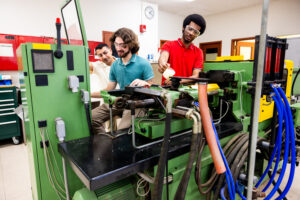
“When I learned about the lab’s innovative work on biodegradable hemp 3D printing filaments, I knew immediately it aligned perfectly with my interests,” Janusz explained.
His research includes developing fiberboard construction materials from hemp, employing manufacturing techniques traditionally used for plywood. Reflecting on his difficulty in handling liquid phenolic resins, he said, “Every attempt initially ended in a mess, but my persistence eventually paid off, developing a novel manufacturing method.”
NIU senior Sarahjean Brown, majoring in mechanical engineering, has extensive experience in materials science and deep concern for the environment. As she spearheads a pioneering project to develop edible and transparent soy protein films aimed at sustainable food packaging, Brown is developing project management skills.
“Initially decision-making felt overwhelming,” she said, “but now I approach planning with confidence and clarity.”
In June, she shared her research at the NIU Convocation Center during the Forward campaign fundraising launch, an opportunity she describes as “exciting and deeply rewarding.”
Mohamed Ahmed, a senior biomedical engineering student from Sudan by way of the United Arab Emirates, brings a global lens to his research. Inspired by climate change, he’s exploring the use of lint—a rare material choice given limited existing literature.
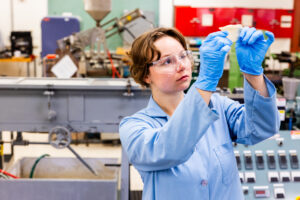
After early experiment challenges, practical lab freedom and theoretical insights provided a breakthrough. He credited Vaezi’s guidance “to identify angles I hadn’t considered” and the lab’s interdisciplinary nature that melds biology, chemistry and the engineering departments.
Another mechanical engineering senior, Calvin Sissel, served five years in the United States Army. He is representative of CEET’s appeal to non-traditional students who draw from an array of professional and personal backgrounds—a diversity that enriches everyone’s experience.
Sissel researches how to integrate wheat straw into plastic polymers to improve material properties and reduce environmental impact. He said meticulous experiment planning and equipment maintenance are key skills cultivated during his lab tenure.
A standout moment was when a new test material exceeded strength expectations.
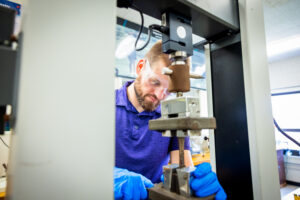
Beyond technical skills, students consistently discover personal growth and unexpected abilities. Through public presentations and conferences, Janusz found a natural aptitude for science communication, while Ahmed realized he possessed patience and adaptability, especially in managing his campus assistant responsibilities.
Mohammad Saadeh, chair of the Department of Engineering Technology, said the lab achieves the broader NIU mission of engaged learning, creating a nurturing environment where undergraduate students not only participate in meaningful research but also develop as leaders who help address critical global challenges.
“These opportunities have a proven record of improving students’ technical abilities and critical thinking beyond regular classroom instruction,” Saadeh said. “Today’s undergrads are tomorrow’s researchers and designers. These experiences emphasize our commitment to invest in our students to distinguish them in an ever-competitive workforce arena.”
To those who doubt their ability to become undergraduate researchers, these students encourage keeping an open mind. “Never underestimate yourself,” Brown said. “Persistence, curiosity, and diverse perspectives often bring the greatest breakthroughs.”
“Apply even if you feel slightly unqualified,” Sissel advised. “Let others decide, don’t self-select yourself out.”
Looking forward, these researchers envision their lab experiences profoundly influencing their professional trajectories.
Janusz plans to continue graduate studies focused on biopolymer composites, aspiring eventually to lead his biomaterials-focused company. Brown aims for a career advocating environmental sustainability within industry, confident that her lab experiences will enable her to inspire greener practices. Ahmed is passionate about applying biomaterials research toward developing advanced prosthetics, and Sissel seeks to create biomaterials replicating traditional plastics’ structural strength while significantly reducing environmental waste.
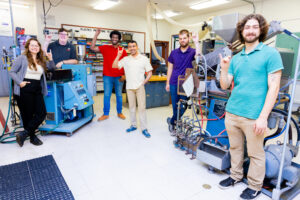
Vaezi emphasized that the NIU Bioplastics Lab is as much about building people as it is about advancing research.
“Our mission is to create an environment where undergraduates can take ownership of meaningful projects from start to finish,” he said. “They’re not just assisting—they’re designing experiments, troubleshooting challenges, and presenting their findings to professional audiences. Watching them grow into confident, capable researchers who can hold their own in any technical discussion is the most rewarding part of my job.”
CEET Dean Dave Grewell praised the lab’s role in preparing students to collaborate across disciplines “in a rapidly evolving, sustainability-driven engineering landscape.”
“This lab exemplifies what sets CEET apart,” Grewell said. “Hands-on innovation with global impact, led by students who aren’t just preparing for the future, they’re shaping it.”
To learn more, visit the Bioplastics Lab web page.
Related: Sustainable innovation thrives at NIU Bioplastics Lab
