
On the homepage of Northern Illinois University’s College of Engineering and Engineering Technology (CEET), a new door has opened for prospective students to explore their future.
It’s the hyperlink to Huskie CEET Pathways, the artificial intelligence (AI)-powered tool that invites visitors to ask questions about the college. What begins as a casual interaction—curiosity about majors, careers or campus life—can swiftly become something more personalized.
The Pathways tool reflects a broader commitment within CEET to meet students where they are, both technologically and educationally, and help guide them through their college experience and into the workforce, said CEET Dean Dave Grewell.
“Accessibility of this kind is essential is today’s world. We’re reimagining how students begin their journey in engineering,” Grewell said. “Today’s learners expect engagement, personalization and immediacy.”
In the case of Pathways, that means going beyond navigating static pages or wading through lengthy program descriptions. Now, prospective students can launch into a dialogue that centers on their interests and addresses their uncertainties.
Grewell developed Pathways through CEET’s subscription to Chipp.ai, a platform that enables customized AI agents.
“We don’t have the luxury to keep doings things the way they’ve always been done,” Grewell said. “Higher education must be nimble and dynamic, and AI is at the heart of that.”
Among other steps in this regard, Grewell has also begun assigning students in his class to deploy AI to make chatbots and podcasts.
AI Deepens CEET’s Recruitment, Retention & Career Readiness
The Pathways “front door” is the first phase of a larger, three-part strategy in which CEET is thoughtfully integrating AI across the student experience. While the college has long offered a range of programs to support recruitment, retention and career readiness, AI now deepens those efforts.
In addition to Pathways, CEET hosts a variety of events that introduce prospective students to the field such as open houses, campus visits, virtual information sessions and National Engineers Week activities.
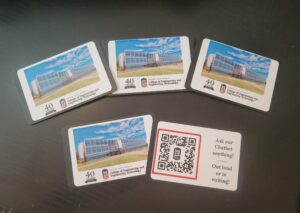
Since February, Grewell and other CEET staff members have been distributing RFID (radio frequency identification) cards at events. The two-sided card conveys CEET’s brick-and-mortar and virtual components: one side displays an image of the Engineering Building beneath a pristine blue sky; the other side features a QR code pointing to the Pathways link along with this note: “Ask our Chatbot anything! Out loud or in writing!”
The on-demand resource helps students explore engineering disciplines, understand program options and begin to see where they might fit.
In doing so, it addresses a common challenge: many students are interested in engineering but unsure where to start. By offering tailored responses based on a student’s questions, Pathways helps lower barriers, demystify the field and encourage exploration without pressure.
Mark Pietrowski, director of CEET’s central advising office, emphasized that Pathways doesn’t replace human interaction, but “it helps those initial conversations with us go further.”
“We’ve found that especially because these tools are relatively new, students still prefer to ask questions of staff,” Pietrowski said. “Pathways enables them to learn more on their own time. This combination of high-tech and high-touch fosters more meaningful in-person interactions.”

That philosophy carries into the second phase of CEET’s AI integration: student success.
Once enrolled, students encounter a variety of academic support systems, including the CEET Success Center, peer mentoring programs, introductory courses such as Engineering Foundations and initiatives like the Engineering Accelerator, a free, immersive experience for incoming freshmen engineering majors that helps them build a strong academic, social and personal foundation before their first class.
Now, CEET is extending that support through AI-powered tutors such as the NIU Calculus Tutor, as well as AI tutors for physics and trigonometry. Available 24/7, these tools provide immediate, personalized assistance—whether a student is working through a difficult concept late at night or preparing for an exam.
Matthew Vanderwater, a junior industrial and systems engineering major and tutor in CEET’s Learning Center, said “it’s great to see the college take the initiative” with its AI focus.
“There’s still a lot of room to grow with AI and I hope that when the college does, these tools can be expanded to include more in-depth engineering coursework beyond the entry-level content,” Vanderwater said.
The third phase of CEET’s AI integration focuses on professional development and career readiness.
Through an AI-driven interview preparation chatbot, CEET helps prepare students for transition into the workforce. The CEET Mock Interview service enables students to practice responding to questions tailored to specific roles and industries.
Combined with internships, senior capstone projects and CEET-hosted job fairs, this tool helps students refine their technical knowledge as well as communication and critical-thinking skills.
John Beard, a member of CEET’s Industrial Advisory Board, said the college’s three-pronged use of AI reflects “a cohesive vision.”
“A lot of places are still treating AI like a set of standalone tools,” said Beard, chief medical officer of GE Healthcare. “What’s different here is how it all fits together in a way that actually supports students. From an industry perspective, we need graduates who are comfortable with AI and know how to apply it. It’s good to see NIU taking that seriously.”
Related: In Northern Now: Dean Dave Grewell’s Bold Vision for CEET Takes Flight
