
As a child growing up in China, Niechen Chen enjoyed tagging along with his father to his job as a mechanical engineer. His father designed gear boxes and bearings for “mother machines,” those machine tools that produce other machines.
A frequent visitor to the factory during his childhood, Niechen would marvel at the process. His passion for engineering had been sparked.
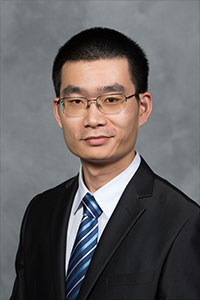
Now, it’s Niechen’s own young son who accompanies him to various College of Engineering and Engineering Technology (CEET) events, such as open houses, STEM Fest, Senior Design Project Showcases, and the Scholarship, Staff, Faculty and Student Awards ceremony at the NIU Convocation Center on May 3.
That’s when Chen, an assistant professor in CEET’s Industrial and Systems Engineering department since 2018, was recognized by Dean David Grewell with the Outstanding Young Researcher Award.
We sat down with Professor Chen to learn more about his journey, including his passion for teaching Huskie students. Here are excerpts of our conversation:
Q: What was your reaction when you found out that you were receiving this award?
A: It’s a big honor. Receiving this recognition really means my efforts and achievements are acknowledged and it has motivated me to keep doing more.
I think it’s all about trying. To get any positive results, you have to try even if there is only a 1 percent chance. That’s the spirit of doing research, especially high-risk research at the scientific level.
As long as we can see a few directions that are possible to achieve a breakthrough in our research, we have to try it out. If no one has been there, you are the one paving new ground and deciding which direction to go. That is really what motivates me—discovering new knowledge and sharing it with my peers.
Q: What’s an example of something you’ve been researching lately?
A: My most recent research involves exploring new AI methods in digital manufacturing. One research direction is using reinforcement learning for machining and additive manufacturing toolpath generation to achieve fully automated beyond human level optimization for various goals such as shortening cycle time, reducing cost and improving sustainability, to name a few. Another is exploring the use of computer vision with AI methods to streamline the robotic assembly process to improve production line efficiency and quality control.
Q: What sparked your interest to pursue this branch of engineering?
A: The idea of realizing something physical out of your imagination is fascinating to me. If you want to have a tool and you want to manufacture it, you can do that. It starts with a thought.
Having a machine that can create a part just by thinking about what you need? When I first learned about that, I thought, `That would be really cool.’ And as I got to know more about manufacturing and then industrial engineering, it broadened my understanding from that one machine to a manufacturing system that covers the entire product realization process.
Q: How do you see the relationship between art and the traditional elements of STEM (Science, Technology, Engineering and Mathematics)?
A: Art is as important as the STEM subjects. It’s essential to have a useful tool, and it’s even better to have a useful tool that’s artistic, that’s something someone wants to look at and actually use.
All the technologies, solutions and methods that we explore, develop, and implement are eventually for humans to use. As the world of industry is becoming more automated, we want to have a better understanding of how machines and technologies can work with humans and work for humans. That is the future Industrial 4.0 with human-in-the-loop we want to see. Without a good grasp of art, which is human’s unique capability, that future of industry cannot be achieved.
Q: When you look at the world, do you see it through the lens of `How was that object made?’ or `How can that thing be improved?’
A: Absolutely. Engineers are inspired by our life experience. I often talk about plastic caps as an example in my classes. The cap that appears on bottled water or soda—you see it as a simple piece or part, but many engineering thoughts are built into it. Why did a lot of early days’ soda caps have a rubber seal? Can that be eliminated? In fact, yes, today’s soda caps can do well without a rubber seal. That’s a great breakthrough in plastic material and injection molding technology.
Can we, in the future, design a cap with fewer turns and perhaps less torque or force to close or open?
Q: What do you enjoy most about teaching?
A: It’s the interaction with students. It’s not about simply passing on information—information is static, but learning is different.
I get to be in the same space with a group of many talented students for one hour, many times for up to three hours. I hear feedback from them, I hear questions from them, and many of those questions inspire me.
Even though someone might ask what seems to be a simple question, it inspires me to look at things from a different perspective, how this problem can be viewed differently, so that I can do more research and give them my answer or a different direction to think about. I love the experience of getting inspired and helping to inspire others. I want to motivate students to stay curious and actively think.
Q: What principles or philosophy do you follow in your teaching approach?
A: It’s so important to understand the logic between the elements first, to connect the dots, before we dive into the details. Everything is logically connected. When reading a paper, for example, you have to understand the purpose of this article.
We have to understand the logic flow first. In teaching, we also try to change how content is organized. How to catch their attention—that should be inspired by a complete logic flow.
Q: What’s it like when you see someone finally understand a concept that they struggled with?
A: That is the most proud part of my work. I’m not just giving information to memorize. Now, they are gaining the information actively themselves, so that perhaps they can create new knowledge, new information. That’s what I think is most important for them: to grow into a life-long learner, beyond their college education.
Learn more about Professor Chen at his faculty page.
