
With a fuel efficiency of 139.6 miles per kilowatt hour (4,705 miles equivalent miles per gallon), the NIU Supermileage competition team added to the student organization’s strong tradition by placing seventh in the prototype battery electric class at the Shell Eco-marathon Americas 2025 earlier this month.
The 13-member crew traveled to the storied Indianapolis Motor Speedway to compete in the event, which draws student teams from throughout the United States and several other countries.
“It went extremely well. This is probably the best the club has done in almost five years,” said Logan Wilson, who just concluded his term as club president. “We’re finally in our recovery phase from COVID. That was my biggest goal: to get us back to the team’s level pre-COVID.”
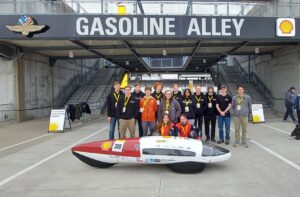
Mechanical Engineering Assistant Professor Eric M. Lee, the team’s advisor, expressed pride in the group.
“The NIU Supermileage is a special club,” Lee said. “Each member brings a spirit of determination and a critical mind, thriving under pressure and rising to meet the challenges of the Shell Eco-marathon at Indianapolis each year.”
The strong showing is an improvement on last year’s ninth place for the team. Getting onto the track at all—particularly for a new vehicle such as the one that Supermileage built this year—is no simple feat, either. As the Shell Eco-marathon website notes:
“Before they get on track, Prototype vehicles need to pass a series of 11 technical inspections. For some, the only goal is getting through this test. Many never even make it that far.”
There were 22 teams who entered the competition in the prototype battery electric category, with five not able to record any qualifying runs and two that didn’t pass technical inspection.
The 11-stage inspection covers checklists that number 136 items overall, spanning a variety of categories such as vehicle weight, brakes, vehicle dimensions, visibility, mechanical vehicle design, electrical vehicle design, and energy verification.
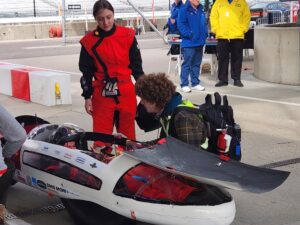
The team’s work culminated an effort that started with a mold created by Supermileage members over four years ago. Team members devoted numerous hours to design development, analysis, and fabrication of the vehicle.
“We built and brought a completely new vehicle in less than a year, which is extremely impressive,” Wilson said. “I’m very proud of everybody who got it done.”
In addition to navigating rainy, cold conditions at the track, the team had some harrowing moments as a tornado came within a few blocks of the hotel where they were staying in Indianapolis. For a few hours, they huddled up inside a stairwell while outside in the parking lot, they had maneuvered the trailer holding the competition vehicle to minimize its vulnerability to the turbulent conditions.
One key part of the strategy within the competition is to complete the four 2.7-mile laps in as close to 35 minutes as possible without going over that limit. The strategy is to accelerate to a pre-determined speed as quickly as possible, then coast as long as possible to maximize efficiency.
On one run, Emily Stewart completed the four laps in about 33 minutes; on a later run, Cameron Czajka did it in about 34 ½ minutes.
That last run occurred after team members fixed a steering system that had broken. The students benefited from the team’s policy of bringing “backups upon backups”.
“Everything,” Wilson said, “is bound to break at some point.”
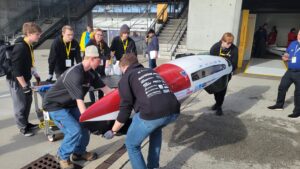
The competition was a good testing ground for members. As Wilson said. “It’s great to see how everyone thinks on their feet, how they respond to something that’s unexpected. It’s a good way to see who can take initiative and get projects done.”
With only two seniors this year (Wilson and Caleb Maue), the team roster has plenty of depth that figures to bring strong experience to Supermileage efforts in the coming years. Here’s this year’s roster, which includes seven mechanical engineering majors, three majoring in electrical engineering, two in mechatronics and one in industrial and systems engineering.
Drivers: Cameron Czajka and Emily Stewart
Electrical team: Cameron Grund (team lead); Zachary Schmidt, Aditi Venktatesh and Ben Whitlock
Mechanical team: Caleb Maue (team lead); Nicholas Schmitt and Ashley Wubben
President: Logan Wilson
Vice President: David Geron
Treasurer: Matthew Vanderwater
Secretary: Kurt Hill
NIU’s Supermileage team started in 2008, first as a senior design project working to improve energy efficiency while maintaining or improving safety. Past laurels have included winning top honors in the overall efficiency category in 2019 for its gasoline-powered vehicle that traveled 1,525 miles on one gallon of gas at the Shell Eco-Marathon Americas competition at Sonoma Raceway. The team’s overall record for gas efficiency is 1,888 miles per gallon, accomplished in 2018.
Eight times in an 11-year span, the team placed in the top three at the SAE Supermileage competition held in Marshall, Michigan. For the coming year, one goal is to have two types of vehicles in competition, returning with a battery electric vehicle and adding one that operates with an internal combustion engine, Wilson said.
To learn more about the NIU Supermileage team, visit its website. You can also find Supermileage on Instagram.
