
For the Northern Illinois University Supermileage Team, success at the 2026 Shell Eco-marathon Americas wasn’t measured only in miles per gallon or efficiency records. Their standout effort at the Indianapolis Motor Speedway in April emerged from late nights in the shop, problems solved through collaboration and confidence borne of struggle.
This year, the student organization reached one of the most significant milestones in its history by bringing two prototype vehicles to competition for the first time: an electric vehicle (EV) and an internal combustion engine (ICE) vehicle. The results reflected months — and in some cases years — of work.
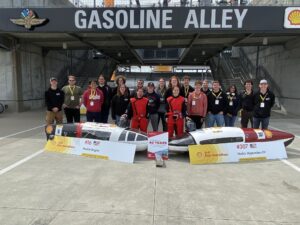
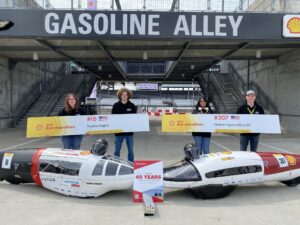
The EV posted a school-record 185 miles per kilowatt-hour, improving on last year’s 140 mi/kWh mark and finishing 10th among 23 EV teams. Meanwhile, the revived ICE vehicle achieved 893 miles per gallon and placed fifth in the Americas, earning the team a $750 award.
But the numbers only hint at the larger story.
“The biggest priority for the team this year and every year is learning,” said team president David Geron. “For me, this year was about learning to be a better leader, planner, communicator and team player.”
The competition, Geron said, became a showcase not only of engineering skill, but of personal growth throughout the organization.
“At competition, I got to see our team members exhibit enormous growth in those qualities as well as their advanced engineering skills,” he said. “It was the culmination of their hard work and dedication this year.”
The team’s ambitious decision to compete with both vehicles “represents one of the most historic milestones for this team,” Geron added. “I think we’ve proven that no matter where the bar gets set, we can surpass it.”
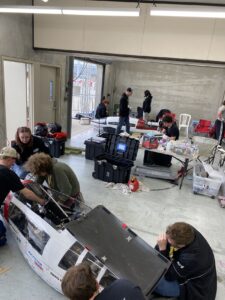
For students like Matthew Vanderwater, the team’s next president, the journey began long before the competition.
During NIU’s Week of Welcome as a freshman nearly three years ago, Vanderwater searched for a student organization that combined community with meaningful engineering work. He found both in Supermileage.
“I wanted a club that had big projects and big goals,” Vanderwater recalled. “When I met the leadership team, they resonated with me. They really cared.”
He quickly immersed himself in the organization, eventually earning a spot on the competition team and later on the executive board.
“It was about finding that community and finding projects to be engaged in,” he said. “I kept asking myself: how can I apply the skills I’m learning to this team?”
Freshman Connor McPartlin experienced something similar this year.
Active in robotics during high school, McPartlin was drawn to the competitive nature of Supermileage and the opportunity to immediately gain hands-on experience.
“I could tell this was a fun but competitive club that would really put in the effort to do well,” McPartlin said. “I also knew I’d quickly be able to get hands-on work, which I really craved as a freshman.”
He soon discovered a welcoming environment where younger members were trusted with meaningful responsibilities.
McPartlin contributed to both vehicles, designing a cold air intake valve for the ICE car while also helping with structural and wheel well components on the EV.
At competition, he got a firsthand taste of the pressure and excitement that comes with high-level engineering competition.
“It felt very real — like actual racing,” McPartlin said. “We had a paddock and worked on the car after it broke. It was exciting to see the fruits of our labor pan out.”
Much of the EV’s success came from the team’s ability to analyze data, refine strategy and make constant adjustments.
Aditi Venkatesh explained that efficiency required far more than simply driving slowly.
“The basis of our strategy is a coast-and-burn method,” she said. “But knowing how the car behaves on the track — its acceleration and deceleration — is just as important.”
The team continuously adapted during competition runs, making adjustments in real time based on vehicle behavior and track conditions.
“No run is perfect,” Venkatesh said. “There are always adjustments that need to be made on the spot.”
She worked alongside teammates Cameron Grund and Vanderwater to optimize the EV’s performance, including refining the motor controller’s PID loop and reducing vehicle weight through battery redesign decisions.
Some of the most pivotal changes were surprisingly small, including increasing tire pressure and lowering the motor’s current limit to reduce unnecessary power consumption.
The result was a breakthrough moment when the team realized the car had already exceeded expectations — even during a flawed run.
“Our very first competition run had several major issues,” Venkatesh said. “We actually expected an efficiency lower than our previous record.”
Instead, the vehicle posted 177 mi/kWh.
“Everyone was cheering and celebrating,” she said. “The real takeaway was that if our worst run produced that result, then we had significant room for improvement.”
On the ICE side, senior Ashley Wubben helped lead the effort to revive a dormant vehicle that had not competed since before the pandemic.
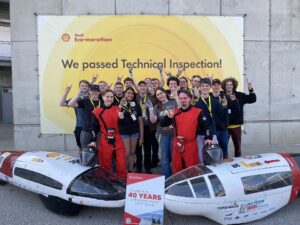
“Overall, the process felt less like building something new and more like bringing something back to life,” Wubben said.
She spent months rebuilding the engine while also learning systems that few current members had experience with. Along the way, alumni support was invaluable.
Former Supermileage president Josh Helsper — whose team once won Shell Eco-marathon with an astounding 1,888 miles per gallon performance — returned to mentor students through the rebuild process.
“He never overstepped or took control,” Wubben said. “He acted as a mentor and let us learn while still keeping us on track. He was exactly the kind of teacher this project needed.”
For Wubben, one of the defining moments came just one week before competition, when the rebuilt ICE vehicle successfully completed laps with a driver inside.
“At the beginning, it honestly felt almost unachievable,” she said. “Then suddenly it was running reliably again.”
The team’s faculty advisor is Eric M. Lee, an assistant professor in CEET’s Department of Mechanical Engineering. He said the team’s journey exemplifies what experiential learning can look like in engineering education.
He noted that most of the graduating team members secured a full-time job before graduation—and before most of their peers—and traced that in part to the maturity they developed in learning to persevere through the Supermileage process.
“Now the torch has been handed over to another leadership,” Lee said. “I cannot wait to learn what their next unimaginable, crazy goals will be.”
