
Capping students’ undergraduate years in NIU’s College of Engineering and Engineering Technology (CEET), our Senior Design Project Showcase drew more than 1,200 people to the NIU Convocation Center May 3.
On display were not only dozens of prototypes and processes geared toward solving challenges in industry, but also students’ determination, creativity and ingenuity.
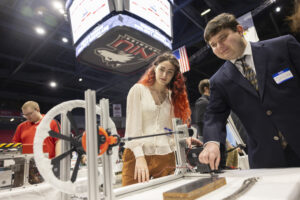
The capstone event for 2024 graduating seniors culminated months of learning. Presented with problems, student teams (most with four students) joined forces with a faculty advisor and business mentor to devise solutions.
The nearly 60 projects covered such diverse topics as improving safety in industrial automation, creating an automated cat-treat dispenser, strengthening robots’ abilities to be autonomous, reducing the time required to inspect a part and performing an energy audit for DuSable Hall.
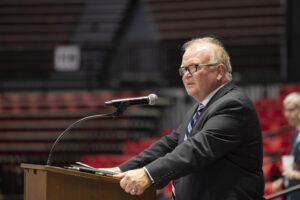
“I am so proud of what these students are doing,” CEET Dean David Grewell told a Rockford television station. “They’ve put it on themselves to learn, go out and challenge themselves.”
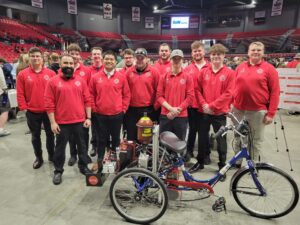
One team developed a fluid-powered bike that had recently gained grand champion recognition at the National Fluid Power Association’s Fluid Power Vehicle Challenge. The team also received top laurels at that national competition for efficiency, endurance and final presentation.
In all, under the guidance of faculty advisor Professor Ghazi Malkawi and teaching assistant David Schmidt, a 12-person team designed and built the bike: Mohamed Alani, Luka Gligorevic, Austin Johnson and Marko Jankovic (hydraulics team); Colton Smeltzer, Brandon Humpal, Colin Rusch and Riley Bell (bike frame team); and Htooler Shee, Max Christensen, Noah Roethle and Andrew Jackson (bike controls team).
In addition to faculty support, alumni and business partners are integral to the showcase’s success. A pivotal partner is the Engineering and Technology Alumni Society (ETAS). On this day, ETAS volunteers served as judges to evaluate teams based on entrepreneurship, quality and standards, manufacturability, and industrial design.
“This is such an extraordinarily formative time for our students, and having the support and engagement from alumni is so valuable,” Grewell said. “We are all grateful for the difference that ETAS makes in their transition to becoming engineering professionals.”
Grewell was also particularly appreciative of event sponsors: Richardson Electronics, Woodward, G&W Electric, R.R. Floody, Fermilab and Collins Aerospace.
Over the years, senior design project collaborations have often led to innovative solutions that have practical applications, including a team in 2018 that improved a company’s production time, potentially saving the company $100,000 a year.
The involvement of industry partners ensures that these projects are academically rigorous and aligned with current market and technological trends. But lessons learned don’t show up always as a tangible component or end product.
Andrew Guidry worked on a project that sought to optimize the inspection of cylindrical parts to make that process more efficient.
“Beyond learning how to make an engineering drawing, this helps a ton with learning how to do company consultation — the aspect of interacting with a company, understanding their needs and then designing from there to meet their needs,” Guidry said.
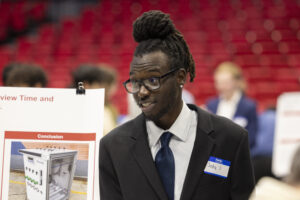
Mo Mashrah, whose team developed an accurate, low-pressure measurement of air flow noted that his project made his prior academic experience come to life, prompting him to revisit a fluid mechanics book, among other things.
“If it works theoretically, [it] does not mean it’s going to work experimentally,” Mashrah said. “I learned that nothing for sure works — the results will always be rooted in physics.”
For one of his teammates, Abdullah Thahab, the experience underscores the importance of allowing for as much lead time as possible when navigating challenges. Two machine parts that he ordered were delayed by nearly two weeks, arriving only a few days before the showcase.
“Just-in-time manufacturing is a myth,” Thahab said. “Always make sure you have your buffers. Expect the unexpected, whether it be lead-in times, whether it be surprise bills. Always be ready to change gears and switch up your ideas.”
Announced toward the conclusion of the four-hour event, the award winners were:
- Alberto Aranda, Genesis Alvizo Serna, Daniel Rodriguez and John Link (Re-Charge Wristband), for entrepreneurship. Faculty advisors: Professor and Director of Mechatronics Engineering YJ Lin and Professor Guangcheng Zhang. Client: Professor Guangcheng Zhang.
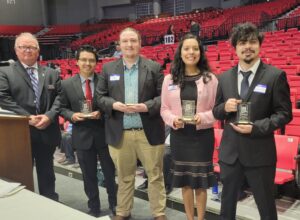
The winning team in the entrepreneurship category.
- Adam Zayed, Tyler Chaney, Joshua Lamkin and Ricardo Ochoa (Danfoss Flow Bench Automation), for quality and standards. Faculty advisors: Professor and Acting Electrical Engineering Chair Donald Zinger and Senior Associate Dean and Professor Mansour Tahernezhadi. Client: Danfoss.
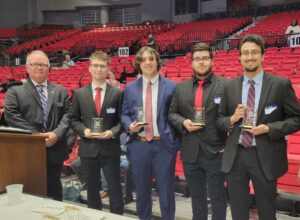
- Jakub Mozdzierz, Kyle Walker, Robin Kostuch and Donovan Reed (PBC Wrapping Robot), for manufacturability. Faculty advisor: Professor Peter Lin. Client: PBC Linear.
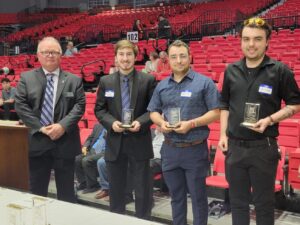
The winning team in the manufacturability category. - Michael Larsen, Adem Dalipi, Tabren Jenkins and Joshua Robinson (Using Automation to Evaluate Oil Pressure Switches), for industrial design. Faculty advisor: Professor Peter Lin. Client: Collins Aerospace.
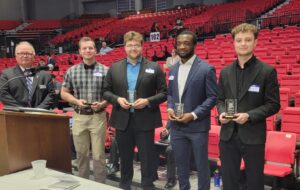
The winning team in the industrial design category.
CEET is seeking projects and sponsors for our 2024-2025 academic year. To learn more, visit our senior design page or contact Matt Baron, CEET marketing and communications director, at mbaron@niu.edu.
